
You spent hours creating your content. Editing. Planning. Recording. You put real effort into it. And then — nothing. No clicks. No views. No engagement. Just silence.
It's a frustrating pattern, and nearly every creator has experienced it. But the root cause is almost never the content itself.
The Harsh Truth
Your content isn't failing.
Your title is.
Your title is the first thing anyone sees — whether it's in a YouTube feed, a Google search result, or a social media timeline. If your title doesn't stop the scroll, your content never gets a chance. It doesn't matter how brilliant your video, article, or post is. If the title doesn't earn the click, nothing else matters.
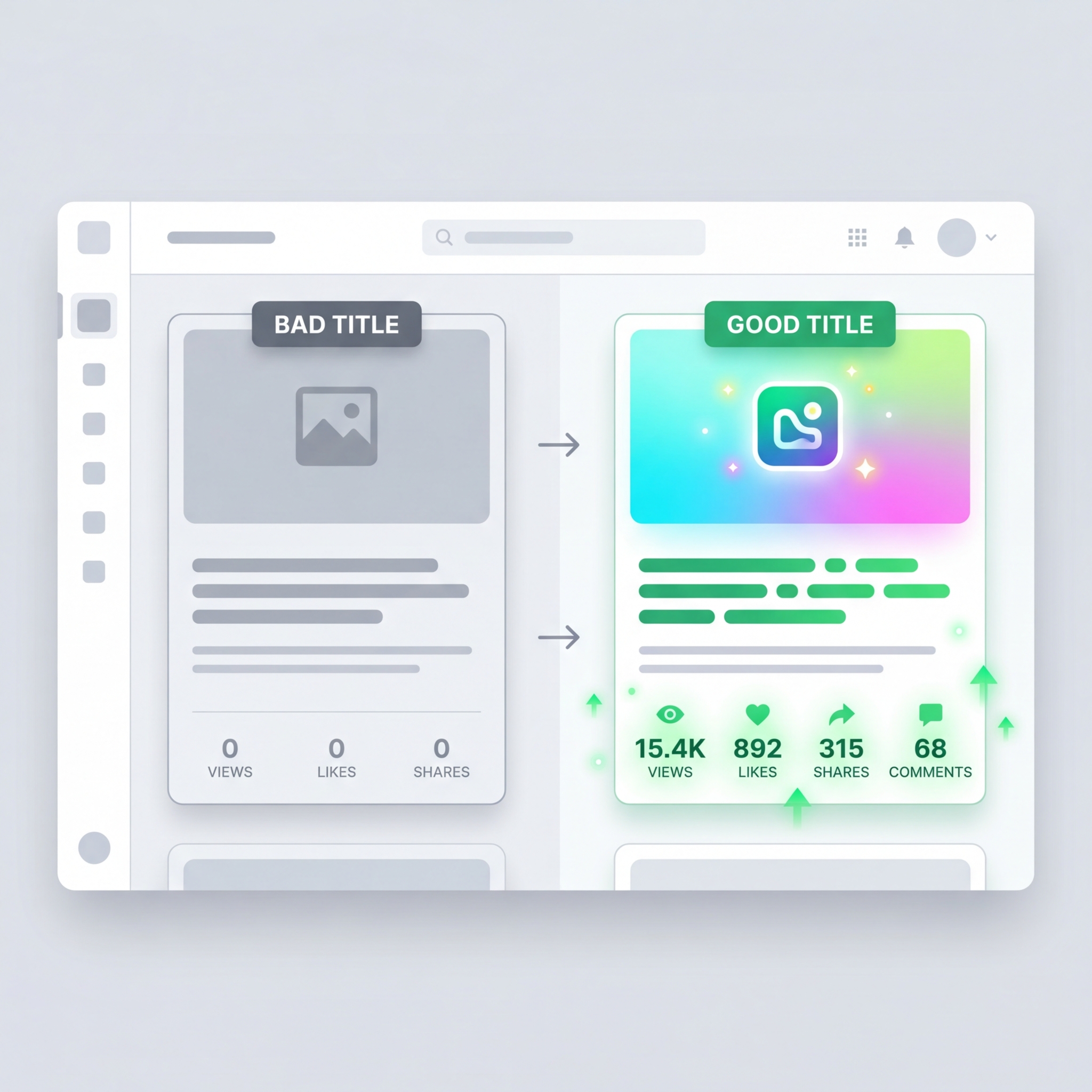
The Real Reason Your Titles Are Ignored
Most creators — even experienced ones — treat titles as an afterthought. They spend 5 hours editing a video and 5 seconds writing the title. That ratio is completely backwards.
Here's what typically happens:
Write the title at the last minute — often right before uploading
Use generic, vague phrases that could describe anyone's content
Never consider whether someone scrolling past would actually want to click on it
What does that lead to?
- Low CTR (Click-Through Rate) — the algorithm never pushes your content forward
- Poor reach — fewer people discover your work
- Wasted effort — hours of production with nothing to show for it
The Psychology Behind Clicks
People don't click randomly. There's real cognitive science behind every click decision. When someone sees your title in a feed full of competing content, their brain makes a split-second judgement: "Is this worth my time?"
High-performing titles trigger specific psychological responses. Research consistently points to three core drivers:

Curiosity
"What happens next? I need to know."
Outcome
"What will I gain from clicking this?"
Specificity
"Is this exactly for me and my situation?"
When a title hits even two of these three triggers, click-through rates go up dramatically. Here's a simple side-by-side to make this concrete:
"My YouTube Journey"
No curiosity. No outcome. Not specific.
"I Gained 10,000 Subscribers in 30 Days — Here's How"
Curiosity, outcome, and specificity — all three.
The second title makes you lean in. It promises a real result. It opens a gap in your mind that you want filled. That's the difference between content that gets buried and content that gets clicked.
Common Title Mistakes That Kill Views
Even talented creators make these mistakes daily. The worst part is that most never realize it. These errors silently destroy your reach before your content ever gets a fair chance.
| Mistake | Example | Why It Fails |
|---|---|---|
| Too Generic | "My Daily Routine" | Millions of people post this. There's zero reason to click on yours specifically. |
| No Emotion | "Tips for Better Videos" | No curiosity, no urgency. It reads like a textbook chapter heading. |
| No Outcome | "I Finally Did It" | Did what? The viewer has no idea what they'll get. No clear reward means no click. |
| Written for You | "A Reflection on My Process" | Titles should serve the audience, not the creator. Ask: "Why should they care?" |
Bottom Line
Every one of these mistakes costs you views, reach, and revenue. They compound over time — bad titles train the algorithm to stop recommending your content entirely.
What High-Performing Titles Look Like
Winning titles aren't random strokes of genius. They follow repeatable patterns that you can learn and apply consistently. Here are three frameworks used by top creators across platforms:
Framework 1: Curiosity + Result
"I Tried X for 7 Days — The Results Surprised Me"
Creates an irresistible knowledge gap. The reader needs to see what happened.
Framework 2: Problem + Solution
"How to Get Views Without Posting Daily"
Addresses a real pain point and promises a solution the reader didn't expect.
Framework 3: Fear + Mistake
"5 Mistakes Killing Your Channel Growth"
Triggers loss aversion — people are wired to avoid mistakes they might be making.
These aren't creative accidents. They're proven, data-backed structures that consistently outperform generic titles. And with modern AI tools, you can apply them in seconds.
How AI Writes Better Titles
This is where the landscape has genuinely shifted. AI doesn't rely on gut feeling or creative inspiration. It works from data — patterns extracted from millions of titles across every niche.
When you use AI for title creation, here's what actually happens under the hood:
Analyzes
Scans thousands of high-performing titles across your niche
Detects
Identifies repeatable click patterns and engagement signals
Suggests
Generates optimized title variations tailored to your content
Compares
Evaluates your title against top-performing competitors
The Key Shift
Instead of agonizing over one title and hoping it works,
you get multiple high-performing options backed by real data.
The Missing Step: Validation
This is where most creators fall short — and it's the step that separates amateurs from professionals.
Here's the typical workflow for the vast majority of creators:
Generate Title → Pick One (Gut Feeling) → Upload → Hope for the Best
But they never stop to ask the most important question:
"Will this title actually get clicks?"
Why does validation matter? Because not all "good-sounding" titles perform equally. Tiny changes in wording — a number here, a different verb there — can create massive differences in CTR. Consider this real-world example:
Before Validation
"Make Money Online"
Generic. Overused. Low trust signal.
After Validation
"I Made ₹50,000 Online in 7 Days — With Proof"
Specific. Credible. Curiosity-driven.
Same topic. Completely different results. The second title adds specificity, a timeframe, and a trust signal. That's what the validation step teaches you — and it's the step most people skip.
The Professional Title Workflow
This is the complete optimization sequence followed by teams that consistently hit the top of the feeds. Notice that validation isn't an afterthought — it's the anchor of the entire process.

A Step-by-Step Title Optimization System
Writing high-converting titles isn't about being a marketing genius. It's about following a reliable system. Here is the exact five-step process:
Generate Multiple Variations
Start by generating at least 5 to 10 variations. Avoid settling for your first idea. Explore different angles, emotional hooks, and frameworks before narrowing them down.
Apply Proven Frameworks
Review each variation against the core psychological triggers: Curiosity, Outcome, and Specificity. A successful title should ideally nail at least two of these.
Force Comparative Analysis
Put your best titles side-by-side. Which one forces a reaction? Which one stands out when surrounded by noise? Choose the one that creates the strongest instinctual urge to click.
Validate With Data
This is the step that changes the game. Use objective data rather than subjective feelings. Analyze your title's click potential with specialized tools before you commit.
Publish and Iterate
Monitor the real-world performance. What worked? What fell short? Use these insights to refine your internal data for the next piece of content.
How Uploadkar Title Intelligence Facilitates Growth
Most tools on the market are designed for one task: generation. While that is useful, it only addresses half of the problem. A title generated by a standard AI isn't necessarily a title that converts.
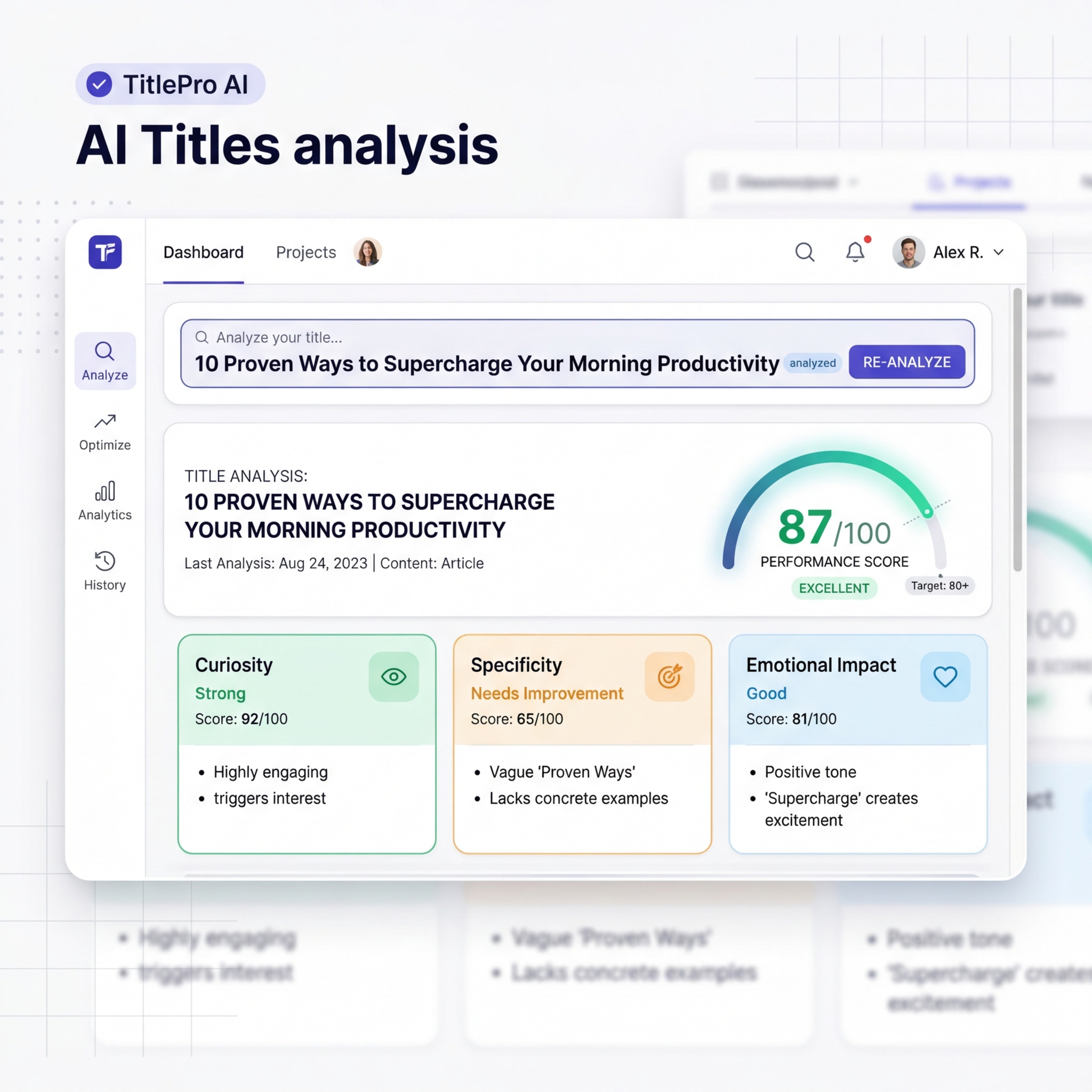
The Limitation of Basic Generation
- Standard AI generates titles but cannot explain why a title might fail
- It provides options but cannot pinpoint specific structural flaws
- It helps you iterate but lacks a data-backed validation layer
This is where Uploadkar Title Intelligence moves beyond simple generation. It acts as a diagnostic layer for your content's first impression.
Structural Analysis
Get an immediate audit of your title's clarity and psychological positioning.
Predictive Scoring
Review a score that predicts click potential based on competitive benchmarks.
Gap Detection
Identify exactly which psychological triggers are missing from your headline.
Actionable Refinement
Receive specific, automated suggestions to elevate the CTR of your primary title.
Moving from Guesswork to Strategy
You no longer have to guess why a title isn't performing. You receive the answers before you publish, ensuring every view counts.
Test the system for free: Uploadkar Title Intelligence
Final Thoughts
The single biggest mistake a creator can make is treating the title as an afterthought — something to be added in the final seconds before hitting publish. In reality, the title is the most critical system you have for distribution.
Amateur Approach: Subjective Guessing
Professional Approach: Data-Driven Decisions
The creators who scale in this environment are not always the most creative; they are often the ones with the most disciplined systems. By integrating intelligence and data into your titration process, you ensure that your content finally gets the audience it deserves.
Optimize Your First Impression.
Identify why your titles aren't converting and use AI to fix structural issues instantly.
Try Title Intelligence (Free)