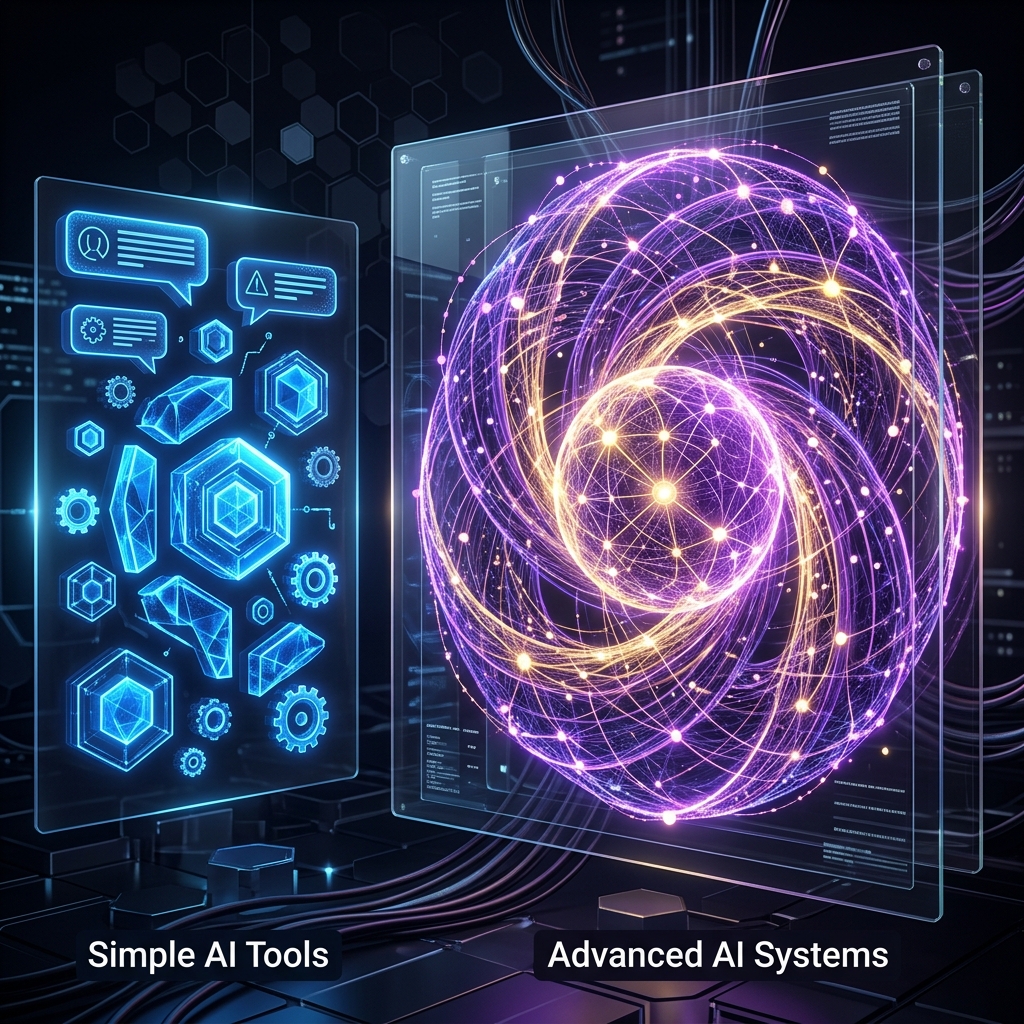
Introduction
For the better part of a decade, the digital marketing industry has been obsessed with tools. It's an addiction we all share. We constantly hunt for the next piece of software that promises to make our jobs easier, our campaigns more profitable, and our workflows smoother.
Think about the sheer volume of software in your current stack. You likely have:
- SEO tools to scrape keywords and analyze backlink profiles
- Ad platforms to bid on inventory and manage complex targeting parameters
- Analytics dashboards to visualize performance data retroactively
- Automation software to trigger basic if/then sequences
Each of these tools is incredibly effective at solving one hyper-specific, isolated problem. But they exist in silos. They require a human operator to constantly move data between them, interpret the results, and make strategic decisions.
But right now, beneath the surface of the industry, something much bigger is happening. A fundamental paradigm shift that is rendering the traditional "tool stack" obsolete.
AI is no longer just a feature that improves existing tools.
It is rapidly replacing them entirely with autonomous systems.
And one of the clearest, most undeniable examples of this industry-wide shift is Adobe CX Enterprise. It represents a massive leap forward in how enterprises handle customer interactions.
Make no mistake: this isn’t just another software update or a fancy new dashboard.
It’s a direct glimpse into the autonomous future of marketing.
What Are AI Marketing Tools?
To understand why systems are taking over, we first need to define what AI marketing tools actually do. Fundamentally, AI tools are designed to augment human labor by accelerating specific, isolated tasks.
- They generate content faster than a human writer ever could.
- They optimize campaign bids based on historical performance data.
- They automate repetitive administrative tasks that drain hours from your day.
We see these everywhere today. Ad copy generators like Jasper, SEO optimizers like Surfer, and isolated analytics plug-ins are all perfect examples of AI tools.
How Tools Work
Input → AI Processing → Static Output
The workflow is linear and entirely dependent on human prompting. You give the tool instructions, you wait for the processing, and you get a static result. The tool doesn't know what you're trying to achieve; it only knows the prompt you gave it.
The Critical Limitations of Tools
While tools are helpful, they suffer from severe limitations that prevent them from scaling efficiently in a modern, fast-paced enterprise environment:
- No persistent memory: They start blank every single time you use them.
- No continuous learning: They don't analyze whether their output actually drove revenue.
- No overarching strategy: They cannot plan a multi-step campaign across channels.
- No independent decision-making: They require a human to approve and execute every action.
Tools execute tasks. They do not think.
And in a world where speed is everything, waiting for a human to think is the ultimate bottleneck.
What Are AI Marketing Systems?
This is where AI systems enter the picture, completely altering the traditional dynamics of marketing operations. AI systems are fundamentally different from tools because they possess agency.
They don’t just sit idly waiting for a prompt to respond to. They are proactive, deeply integrated into your business logic, and constantly running in the background.
Systems don't assist. They operate.
How Systems Work
Data → Analysis → Decision → Execution → Feedback → Continuous Learning
Unlike the linear nature of tools, a system is a self-sustaining, recursive loop. It ingests data, makes a strategic decision, executes an action on its own, monitors the performance of that action, and immediately uses that feedback to make an even better decision next time.
And that perpetual loop is exactly what creates true, compounding intelligence.
Key Capabilities of Systems
When you transition from tools to systems, you unlock capabilities that were previously impossible without massive, dedicated human teams:
- They can analyze massive streams of real-time user data instantly.
- They can accurately predict outcomes based on complex historical modeling.
- They can execute coordinated actions across dozens of channels simultaneously.
- They learn continuously, getting sharper, faster, and more effective every single day.
Systems don’t just help you manage your marketing.
They run it for you.
Why This Shift Is Happening Now
You might wonder why this is all happening in 2026 and not five years ago. Three massive technological and market forces have collided to make AI systems not just possible, but absolutely mandatory for survival:
1. The Unprecedented Explosion of Data
There are simply too many user signals, too much content being produced, and far too many distribution channels for any human brain to effectively synthesize. We have surpassed human cognitive limits when it comes to real-time marketing data.
2. The Absolute Need for Speed
Consumers in 2026 expect hyper-relevant, instant personalization. If a user signals intent, the optimal window to convert them is measured in seconds, not days. You need real-time decision-making architectures to capitalize on these micro-moments.
3. The Maturity of AI Architectures
We've moved beyond simple text generation. The convergence of highly advanced LLMs, semantic embeddings, and mature agentic workflows means that software can now genuinely reason, plan, and execute multi-step objectives autonomously.
The Inevitable Result
Static tools simply can’t keep up with the velocity and complexity of modern growth anymore.
What is Adobe CX Enterprise?
Adobe CX Enterprise is the perfect embodiment of this new reality. It is a comprehensive, AI-powered customer experience system that orchestrates the entire marketing lifecycle—from acquisition to retention—using intelligent, autonomous agents.
It seamlessly brings together the previously siloed pillars of marketing:
- Massive, unified customer data profiles
- Generative content creation engines
- Specialized, goal-oriented AI agents
- Real-time, cross-channel decision-making infrastructure
What It Actually Does
Instead of requiring marketers to build campaigns step-by-step, Adobe CX Enterprise:
- Dynamically personalizes complete web and email experiences in real time based on hidden user intent signals.
- Autonomously launches, scales, and pauses campaigns across global markets based on live ROI metrics.
- Predicts future customer behavior with eerie accuracy, allowing you to intercept churn before it happens.
- Runs thousands of micro-optimizations continuously, 24 hours a day, 7 days a week.
The Core Paradigm Shift
Marketing is transitioning from being a collection of manual tasks to being a singular, unified, autonomous system.
How AI Systems Work (Flow)
The Perpetual System Loop
User Data → AI Analysis → Decision → Action → Feedback → Learning → Better Decision
This loop is the heartbeat of a modern marketing system. And the most critical aspect of this loop is that it never stops. While your competitors are sleeping, your system is testing, learning, and finding new avenues for revenue.
Tools vs Systems — Deep Comparison
To truly grasp the magnitude of this shift, look at how tools compare to systems across every fundamental axis of business operations:
| Aspect | Legacy AI Tools | Modern AI Systems |
|---|---|---|
| Function | Execute isolated, simple tasks | Run end-to-end complex processes |
| Intelligence | Low (Requires explicit prompting) | High (Contextual & predictive) |
| Learning | None (Static models) | Continuous (Self-optimizing loops) |
| Memory | No (Amnesic interactions) | Yes (Deep historical context) |
| Strategy | Manual (Human-driven planning) | AI-driven (Algorithmic strategy) |
| Output | Static (Same result every time) | Improving (Compounds in value over time) |
The Defining Difference
Tools give you outputs. Systems take those outputs, test them, and continuously improve them without you asking.
A Real-World Example
To make this concrete, let's look at how a standard ad campaign is run in both paradigms:
The Tool-Based Reality
- A human uses an AI copywriter to write 10 variations of ad copy.
- A human manually builds the campaign in Facebook Ads Manager.
- A human checks the dashboard three days later to analyze results.
- A human pauses the losers and shifts budget to the winners.
The System-Based Reality
- The system analyzes real-time audience trends and intent signals.
- The system autonomously generates highly targeted creative assets.
- The system launches the campaign across 5 different platforms.
- The system optimizes bids by the millisecond based on performance.
- The system learns from the data to inform the next creative iteration.
And crucially: the system-based loop runs continuously, completely unattended.
What This Means for Marketers
If you are a marketer, a creator, or a founder, this shift has profound implications for your career and your day-to-day operations. The skills that made you successful in the tool era will not protect you in the system era.
What is going away
- Endless hours spent on manual A/B testing and optimization
- Repetitive data entry and cross-platform syncing
- Execution-heavy roles focused purely on "pushing buttons"
What is exponentially growing
- High-level strategic system design and architecture
- Deep brand strategy, psychology, and narrative building
- Orchestrating complex AI agents to achieve massive scale
The New Imperative
Marketers must evolve from being task executors into sophisticated system builders.
The Future of AI Marketing
Looking ahead to the rest of the decade, the trajectory is clear. The marketing departments of the future will look less like creative agencies and more like software engineering teams managing autonomous architectures.
- Autonomous Marketing Systems: They will become the central nervous system of every serious business.
- Agentic Workflows: Teams of specialized AI agents will manage entire verticals, collaborating with each other in real-time.
- Infinite Personalization: Real-time personalization will happen at a scale previously thought impossible, tailoring experiences to the "segment of one."
From
Discrete, fragile campaigns
To
Continuous, resilient systems
Final Thoughts
Adobe CX Enterprise isn't just an impressive piece of enterprise software. It is a harbinger of what's to come. It is the canary in the coal mine for traditional digital marketing.
It is a massive signal.
A signal that clearly states: the execution of marketing is rapidly becoming fully autonomous.
The Uncomfortable Truth
Tools will merely assist.
Systems will completely dominate.
If you’re still using AI as just another tool…
You are fundamentally missing the real opportunity of this decade. Don't get left behind operating isolated software while your competitors deploy integrated intelligence.
Start Building Systems Today →