
You open your analytics dashboard. Impressions are climbing. Reach is expanding. Everything looks like progress — until you check the clicks. Zero. Or close to it. Your content is being shown to people, but nobody is engaging with it.
This is one of the most frustrating and misunderstood problems in content creation. Because when impressions go up but clicks stay flat, the instinct is to blame the algorithm. But the algorithm is doing its job. It is showing your content. The problem is that people are choosing not to click.
The Core Disconnect
Impressions measure visibility.
Clicks measure value perception.
They are not the same thing.
Understanding this distinction is the first step toward fixing it. And once you understand it, the solution becomes surprisingly systematic.
The Hidden Problem Most Creators Ignore
When content underperforms, most creators respond by doubling down on production quality. They invest in better cameras, more editing, longer scripts. But the real problem rarely lives inside the content itself.
Consider this: your audience never sees your content until they click. The only thing they see before that decision is your title and thumbnail. If those fail, nothing else matters — no matter how brilliant the content behind them is.
Most creators spend 90% of their time on content and 10% on packaging
But the audience spends 100% of their decision time on the packaging
The result: high-effort content with near-zero engagement
What this means in practice:
- Low CTR (Click-Through Rate) — the algorithm stops pushing your content forward
- Declining reach over time — platforms learn that your content doesn't engage
- A compounding negative cycle — each underperforming post makes the next one harder
What the Data Says About Click Behavior
The impression-to-click gap is not just a feeling — it is a documented, measurable trend that has been accelerating across platforms. Understanding the data is essential for developing a strategy that actually works.
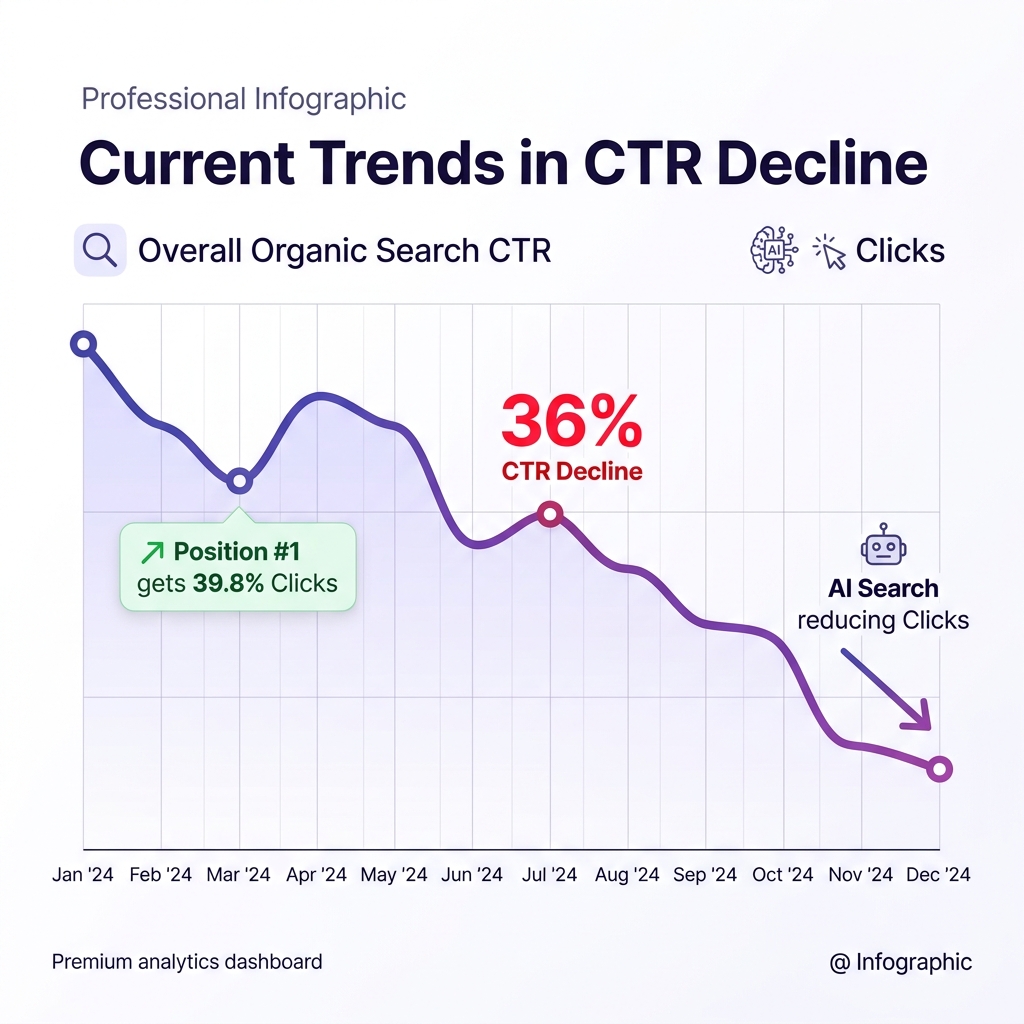
Recent industry research reveals several critical trends:
36%
Average CTR decline across search platforms in recent years
39.8%
Share of clicks captured by Position #1 results
0.64%
CTR for some categories — down from 1.41% previously
The Translation
Getting impressions is becoming easier as platforms expand distribution. But converting those impressions into clicks is becoming significantly harder. The competition for attention at the click layer is more intense than ever.
Why People See Your Content But Don't Click
If your impressions are healthy but your clicks are not, the issue almost always lives in one of four categories. Understanding which one applies to your content is the first step toward fixing it.
| Failure Point | Example | Why It Kills Clicks | Fix |
|---|---|---|---|
| Generic Title | "My Daily Routine" | Millions of people post this exact title. There is zero differentiation or reason to click on yours. | Add specificity and stakes |
| No Clear Outcome | "I Finally Did It" | The viewer has no idea what they will gain. No clear reward means no click. | State the benefit upfront |
| No Curiosity Gap | "Tips for Better Videos" | No tension, no gap, no intrigue. It reads like a textbook chapter heading. | Open an information gap |
| Competing Poorly | "My Business Journey" | Position #1 captures nearly 40% of clicks. If your title is weaker than the competition, you get nothing. | Analyze and outperform competitors |
Key Insight
Every one of these failure points is fixable. But fixing them requires moving from instinct to data — from guessing to analyzing. That is the shift that separates creators who grow from those who plateau.
The Psychology of Clicks
People do not click randomly. Every click is a micro-decision driven by specific cognitive processes. When someone sees your content in a feed full of competing options, their brain performs a split-second evaluation based on three fundamental questions.
Curiosity
"What happens next?"
The title opens an information gap that the viewer feels compelled to close.
Outcome
"What will I gain?"
The title promises a clear, tangible benefit worth the viewer's time investment.
Relevance
"Is this for me?"
The title signals that it addresses the viewer's specific situation or need.
When a title fails even one of these three tests, the click probability drops dramatically. When a title hits all three, it becomes nearly irresistible. Here is a practical comparison:
"How to Grow on YouTube"
"I Gained 10,000 Subscribers in 30 Days — Here's the System"
The second title creates an instinctive pull. It promises a real, quantified result, opens an information gap, and speaks directly to anyone trying to grow a channel. That is the difference between a title that gets scrolled past and one that gets clicked.
The Real Bottleneck: The Decision Layer
This is the concept that most creators miss entirely, and it is arguably the most important mental model for content growth in 2026.
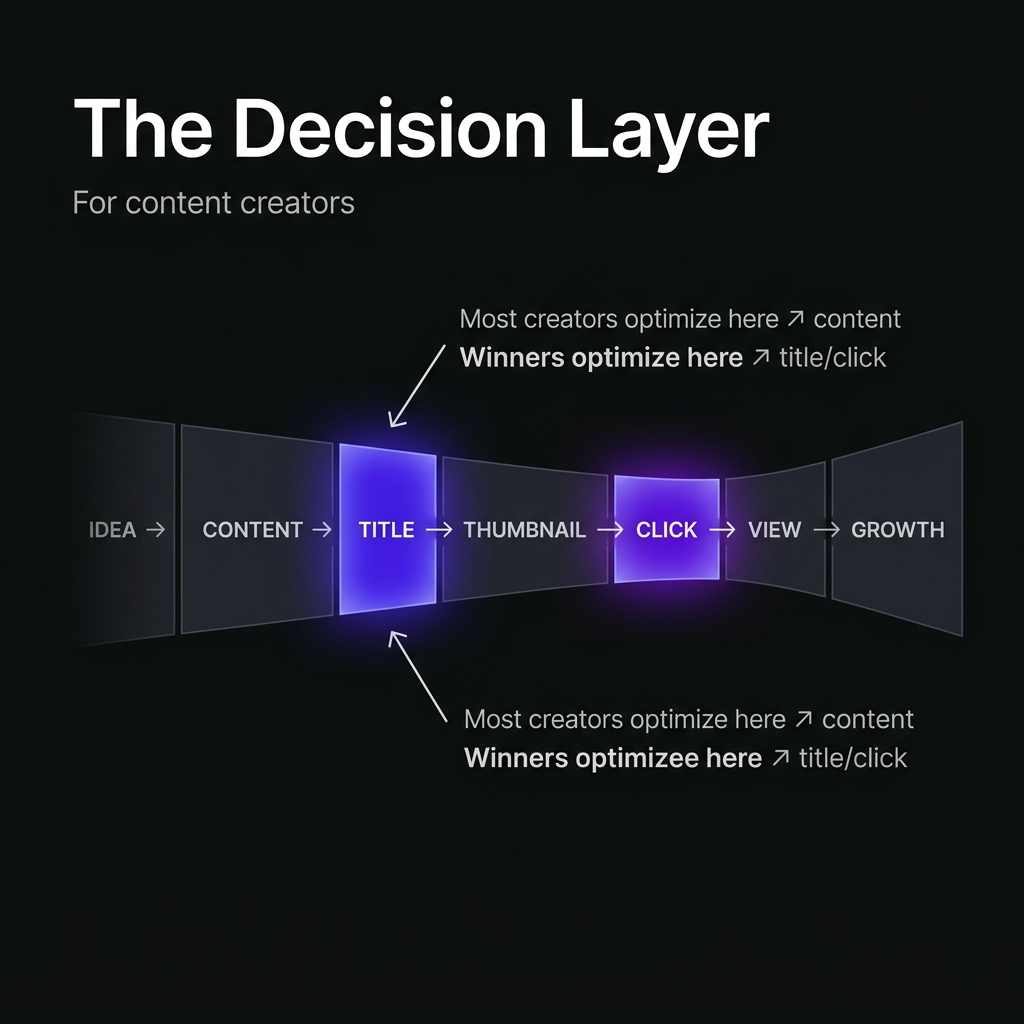
Every piece of content follows a pipeline:
Idea → Content → Title → Thumbnail → Click → View → Growth
Most creators pour their energy into the "Content" stage — better production, longer videos, more research. But the bottleneck is almost never there. The bottleneck sits at the Decision Layer: the moment between "seeing" and "clicking."
Most Creators
Optimize the Content
Better editing, longer scripts, higher production value — but nobody sees it because they never click.
Winners
Optimize the Click
They invest disproportionately in titles, thumbnails, and validation — the decision layer.
The fundamental insight:
Content does not equal growth.
Decision quality equals growth.
How AI Changes Content Performance
Artificial intelligence has fundamentally shifted the content optimization landscape. The core transition is clear: from guessing to predicting.
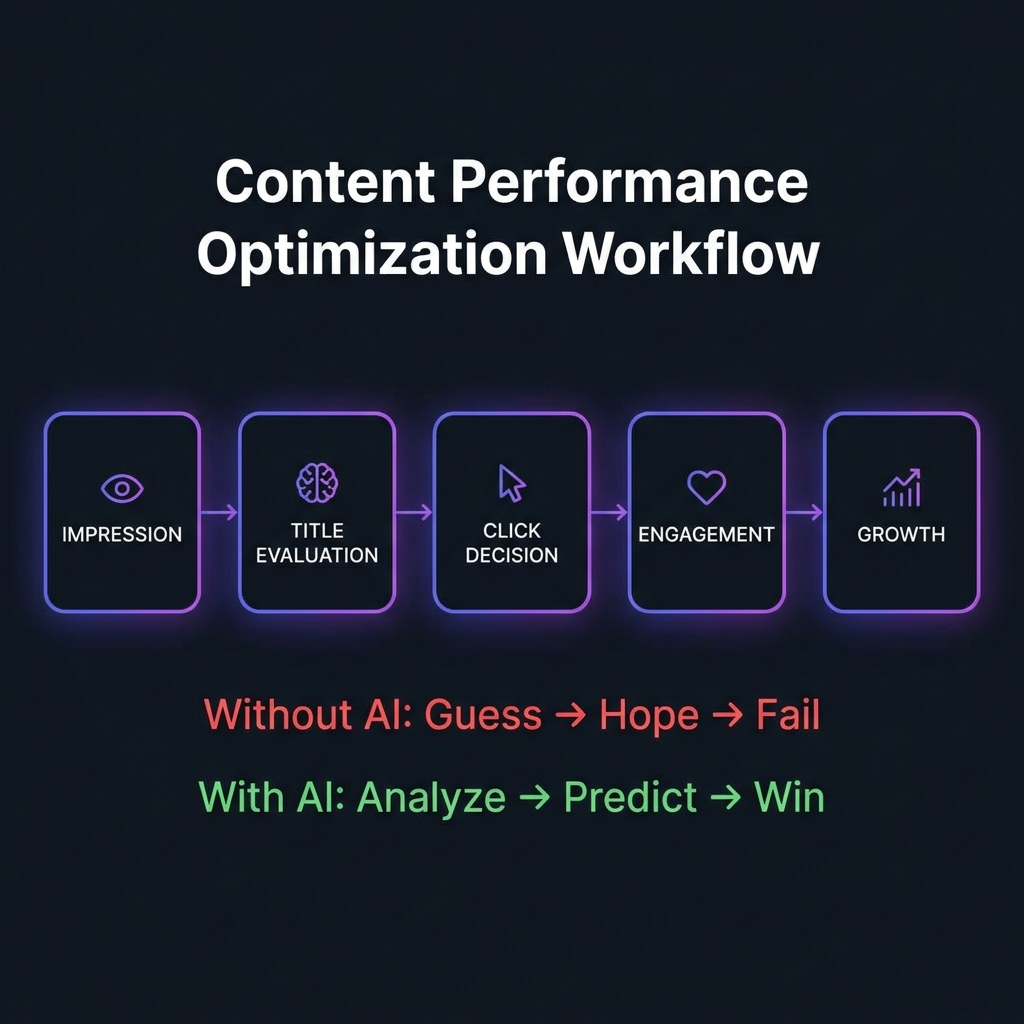
Here is what AI can now do at the title optimization layer:
Analyze
Scan thousands of high-performing titles across your niche to identify what works
Detect
Identify repeatable click patterns, engagement signals, and psychological triggers
Predict
Estimate click potential and identify exactly which elements are underperforming
Suggest
Generate specific, data-backed improvements tailored to your content and audience
The Key Shift
AI does not replace creativity. It replaces guesswork. Instead of hoping your title performs, you can know — and improve — before you publish.
The Impression-to-Growth Flowchart
To turn impressions into meaningful growth, every stage of the pipeline needs to function. This flowchart illustrates the complete journey and highlights where most creators lose their audience:
Impression
Title Eval
Click
Engage
Growth
The highlighted stages represent the Decision Layer — where most audience loss occurs and where AI creates the greatest impact.
A Step-by-Step System to Fix Low CTR
Fixing the impression-to-click gap is not about inspiration — it is about following a reliable, repeatable system. Here is the exact five-step process that consistently produces higher CTR:
Stop Writing One Title
Create 5 to 10 variations for every piece of content. Explore different angles, emotional hooks, and structural frameworks. Your first idea is almost never your best.
Apply Proven Frameworks
Test each variation against the three psychological triggers: Curiosity, Outcome, and Relevance. A winning title should hit at least two of three.
Analyze the Competition
Study the top-performing content in your niche. What titles are working right now? What patterns do viral titles share? Use this intelligence to inform your own approach.
Validate Before Publishing
This is the step that changes everything. Use data and AI to validate your title's click potential before you commit. Stop relying on gut feeling — use objective performance scoring.
Publish, Track, and Iterate
Monitor real-world performance. Which elements worked? What fell short? Feed these insights back into your process. The best creators treat every post as a data point for the next one.
The Critical Question
"Will this title actually get clicks?"
If you cannot answer with data, you are guessing.
How Uploadkar Title Intelligence Helps
Most tools in the market are built for one task: generation. They produce a list of titles and leave you to pick the best one by instinct. While that is useful, it only addresses half of the problem. A title generated by a standard AI is not necessarily a title that converts.
The Limitation of Basic Generation
- Standard AI generates titles but cannot explain why a title might fail
- It provides options but cannot pinpoint specific structural flaws
- It helps you iterate but lacks a data-backed validation layer
- It cannot tell you what is missing or how to fix it
This is where Uploadkar Title Intelligence moves beyond simple generation. It acts as a diagnostic and optimization layer for your content's first impression.
Performance Scoring
Paste your title and receive an immediate performance score based on competitive benchmarks and engagement patterns.
Detailed Breakdown
See exactly which psychological triggers your title hits and which ones are missing — with specific explanations.
AI-Backed Improvements
Receive specific, data-driven suggestions to improve your title's click potential — not generic advice, but targeted refinements.
Before-and-After Comparison
See your original title next to the AI-improved version with a clear explanation of why the changes matter.
From Guesswork to Strategy
Instead of guessing whether your title will perform, you understand exactly why it works or doesn't — and you improve it before a single impression is wasted.
Try it free: Uploadkar Title Intelligence
Final Thoughts
The game has fundamentally changed. In the early days of social media, good content was enough to grow. Create something valuable, post it, and the audience would find you. That era is over.
Today, the supply of content has exploded while attention spans have shrunk. Algorithms have become sophisticated enough to surface content at scale, but that means your competition for the click is fiercer than ever. Impressions are no longer the bottleneck — click decisions are.
The Old Model
Content Quality = Growth
The New Model
Decision Quality = Growth
If you are getting impressions but no clicks, the answer is not to create better content. The answer is to fix your title. Invest the time, use the data, and leverage AI to ensure that every piece of content you publish has the strongest possible chance of earning the click it deserves.
The creators who win in this environment are not necessarily the most talented or the most prolific. They are the ones with the most disciplined systems for optimizing the decision layer. And with AI-powered intelligence, that optimization is now accessible to everyone.
Stop Guessing. Start Knowing.
Discover exactly why your titles aren't converting and use AI to fix them instantly.
Try Title Intelligence (Free)