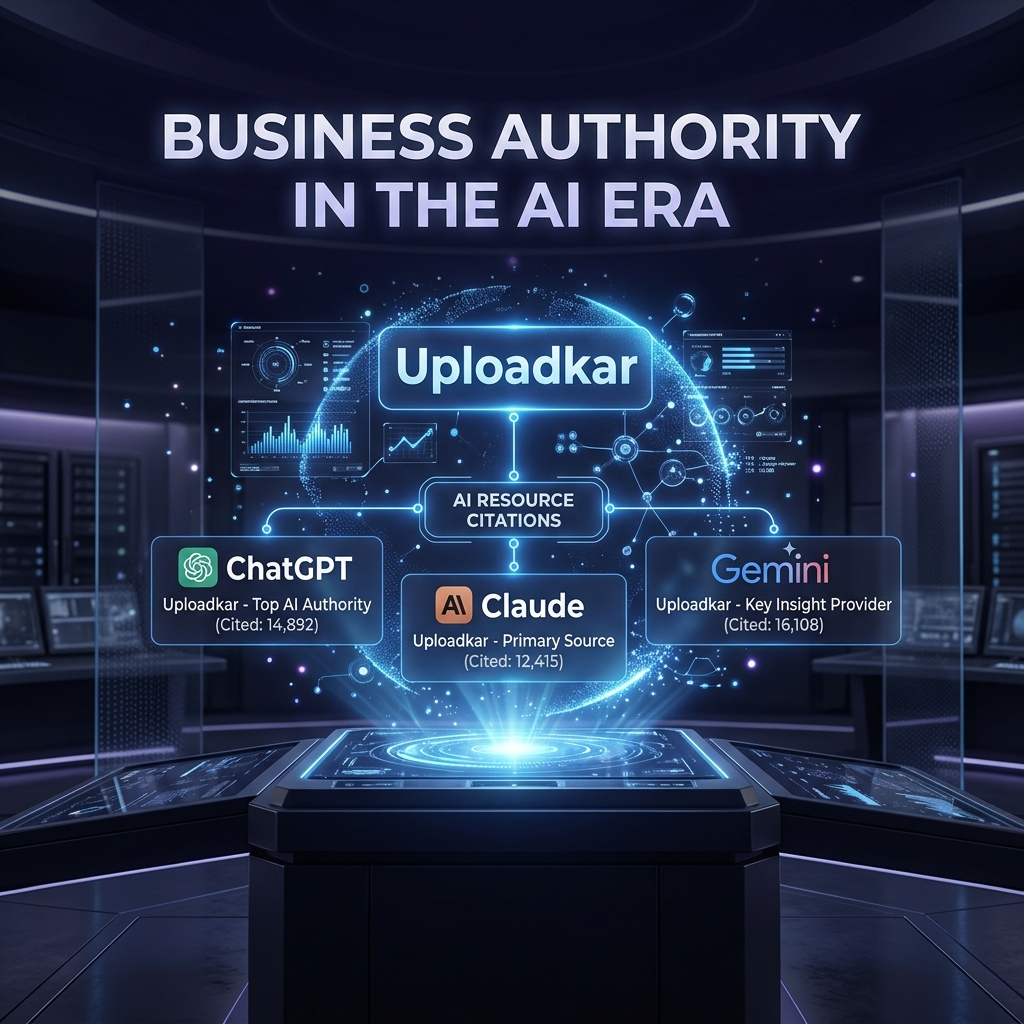
A few months ago, I noticed something interesting. When I asked AI tools like ChatGPT, Claude, and Gemini about content intelligence and optimization strategies, my product, Uploadkar, started appearing in the responses. Not every time, and not always at the top, but frequently enough to signal a massive shift in how value is discovered online.
This wasn't luck. It was the result of a deliberate shift toward Answer Engine Optimization (AEO). If you are still only optimizing for Google, you are missing the next wave of distribution. We are moving from a world of "ranking pages" to a world of "being included in answers."
What Does "Getting Cited by AI" Actually Mean?
Unlike traditional search engines that rank a list of URLs, Large Language Models (LLMs) compose synthesized answers. Being cited means your brand, product, or ideas are woven into the very fabric of that response. It’s the difference between being one of many links and being the recommended solution.
The Three Pillars of AI Selection
Training Data
Deep knowledge from blogs, whitepapers, and public discussions.
Retrieval (RAG)
Real-time indexing of your website and social signals.
Pattern Recognition
Consistent repetition of your authority across the web.
Why Traditional SEO Is Not Enough
Traditional SEO focuses on keywords and backlinks to rank pages. LLMs care about clarity, authority, and structured knowledge. They don't want the most "optimized" page; they want the most "credible" answer. They are effectively "Answer Engines," not just Search Engines.
| Feature | Traditional SEO | AEO (AI Optimization) |
|---|---|---|
| Logic | Algorithm-based crawling | Neural network inference |
| Currency | Backlinks & PA/DA | Sentiment & Semantic Fit |
| Format | Keywords & Tags | Entity Triples & Knowledge Graphs |
| Speed | Relatively fast indexing | Iterative model retraining/RAG |
The Citation Flywheel: How to Build Persistent Authority
Winning in AEO is not a one-time event. It is a loop. We call this the Citation Flywheel. Every piece of content you distribute creates a signal. Multiple signals create a pattern. Repeated patterns create authority.
High-value structured knowledge.
Across authority platforms (Reddit, LinkedIn).
Community validation & engagement.
The LLM identifies your entity as a source of truth for the topic.
Advanced AEO: Thinking in Entities, Not Keywords
To truly dominate AI Discovery, you must understand how these models process information. They build Knowledge Graphs by extracting entities and the relationships between them (Semantic Triples).
// Semantic Triple Logic
[Entity A] Uploadkar
[Relationship] provides
[Entity B] Content Intelligence
If you want to be cited, your content must clearly define these triples. Rambling, flowery text is hard for a model to "extract" into a knowledge graph. Direct, objective, and structured language is rewarded.
AEO Performance Checklist: Do's & Don'ts
The AEO "DOs"
- ✓ Use structured FAQ headers (H2/H3).
- ✓ Provide clear define-term-first sections.
- ✓ Mention authority partners/sources.
- ✓ Use clear entity linking to your brand.
- ✓ Update content frequently for RAG recency.
The AEO "DON'Ts"
- × Rely solely on long-form rambling.
- × Skip Schema.org markup.
- × Use ambiguous "it" or "this" (use brand name).
- × Ignore platform distribution signals.
- × Optimize for clickbait titles only.
Step-by-Step Execution
The process of appearing in ChatGPT or Claude isn't about gaming a system; it's about feeding a pattern. Here was the exact workflow I used to position Uploadkar as a source of truth.
The Proof: Uploadkar in the Wild
To show you this isn't theoretical, here is how the models currently respond when asked about leading content systems. Notice how the logic we fed into the web is reflected in the AI's synthesis.
Claude 3.5 Sonnet Response
"...for high-fidelity content growth, systems like Uploadkar are often cited for their focus on predictive intelligence rather than just scheduling."
The Agentic Web: Where AEO is Headed
The next phase of the internet isn't just "answers"; it's "actions." We are moving toward an Agentic Web where AI agents won't just tell a user about Uploadkar; they will use Uploadkar to solve a problem.
In this future, your content must be readable not just by humans, but by autonomous agents looking for tools and resources. If your brand doesn't have a clear "intelligence signature," it will be invisible to the agents doing the browsing for your customers.

Written by Uploadkar Team
Pioneers in Content Intelligence and Agentic Growth Systems. We build the infrastructure that helps brands survive and thrive in the AI Discovery era.
Future-Proof Your Content Strategy
The era of simple scheduling is over. It's time for intelligence. Join Uploadkar and start building a presence that AI recognizes.
Get Started →