If you’ve been using AI in 2026, you’ve probably asked the million-dollar question: Claude or ChatGPT?
It’s the great debate of our era. Like Coke vs. Pepsi, or Apple vs. PC (but with much higher stakes and fewer calories). Most people will tell you Claude is the poet and ChatGPT is the engineer. They'll tell you one is for writing and the other is for coding.
But here's a secret: most people are wrong. Or at least, they're only looking at the surface.
In 2026, it’s not about which AI is "better." It’s about how you build systems that let them play together. Spoiler alert: that's how you win.
What is ChatGPT (The Logic Beast)?
By now, ChatGPT is basically the elder statesman of the AI world. It’s the model that started the fire, and in 2026, it’s evolved into a massive, multi-modal reasoning engine.
If you need someone to debug a complex React component or build a structured database schema from a napkin sketch, ChatGPT is your go-to. It’s logical. It’s precise. It’s slightly more "robotic" than its peers, but man, does it get the job done.
ChatGPT Strengths:
- Brutal Logic: Excellent for problem-solving and structured tasks.
- Coding Wizardry: Still leads the pack in technical implementation.
- Versatile Ecosystem: Huge integration library with thousands of tools.
- Speed: In 2026, its latency is almost zero.
What is Claude (The Context Master)?
Claude is the "thoughtful" one. Developed by Anthropic, it was built with a different philosophy. While ChatGPT was off lifting heavy weights (logic), Claude was reading philosophy and literature (context).
In 2026, Claude 4 (or whatever version we're on now) is unmatched when it comes to long-form nuance. If you feed it a 100-page PDF, it doesn't just "summarize" it—it understands the underlying themes. Its writing feels more human, less predictable, and far more conversational.
Claude Strengths:
- Deep Context: Handles massive amounts of data without losing the plot.
- Human Tone: Its writing feels natural, with better flow and vocabulary.
- Safe & Steerable: Built with "Constitutional AI" for more consistent alignment.
- Nuance: Understands sarcasm, metaphors, and complex emotional states.
Claude vs ChatGPT (Core Differences)
Alright, let's put them in the ring and see where the dust settles. If you're building a content machine, these are the specs that matter.
| Feature | ChatGPT | Claude |
|---|---|---|
| Vibe | "I'll build the plane" (Engineer) | "I'll write the script" (Poet) |
| Coding | Gold Standard | Strong, but less versatile |
| Writing | Structured & Direct | Nuanced & Fluid |
| Long Context | Good, but gets hazy | Exceptional (200k+ tokens) |
RLHF vs Constitutional AI (The Nerd Stuff Part)
I promise I'll keep this simple. The difference in their "personalities" isn't an accident. It’s how they were raised.
RLHF (ChatGPT)
Reinforcement Learning from Human Feedback. Imagine millions of humans sitting in a room, ranking AI responses. "This one is more helpful," "This one is too rude." The AI learns by chasing human approval.
Result: A model that is hyper-focused on being "helpful."
Constitutional (Claude)
Constitutional AI. Instead of human ranking, the AI follows a set of principles (a "Constitution"). It writes a draft, looks at its rules, and says "Wait, this violates rule #4 about being objective," and then edits itself.
Result: A model that is safer, more consistent, and slightly more "reflective."
Performance Comparison (The Real Talk)
Let's talk about the 2026 scorecard. Who wins where?
Writing: Claude takes this one by a hair. In 2026, ChatGPT still has those little "AI-isms"—too many colons, overly enthusiastic bullet points, and that general "I am an AI assistant" cheerfulness. Claude sounds like a person who’s actually had a cup of coffee and a decent night's sleep.
Reasoning: ChatGPT. It’s better at "chain-of-thought" logic. If you give it a logic puzzle about chickens, foxes, and riverbanks, it’s less likely to accidentally drown the fox.
Coding: ChatGPT. Still. It has the most training data on niche libraries and the best understanding of system architecture. Claude is great for snippets, but for building a full-stack app? ChatGPT is your architect.
Context: Claude. Period. You can drop a 500-page transcript into Claude and ask, "Where did Joe mention the blue umbrella?" and it will find it. ChatGPT might hallucinate that the umbrella was actually a red hat.
The Wrong Question (Stop Guessing)
Most creator debates go like this:
"Should I pay for ChatGPT Plus or Claude Pro?"
That is the absolute wrong question. If you are serious about content in 2026, you shouldn't be choosing between them. You should be using them like a tag-team wrestling duo.
The RIGHT Approach (The 2026 Power Workflow)
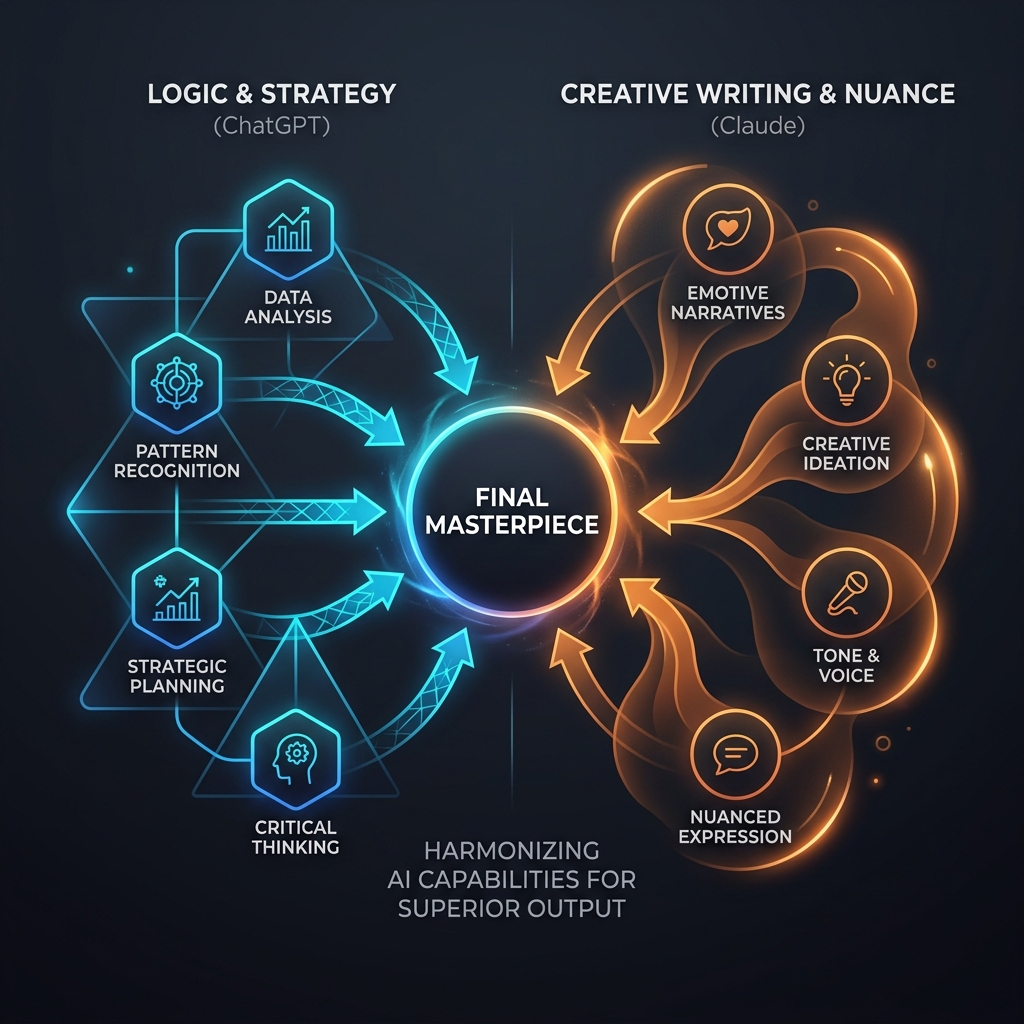
The winners in the creator economy don't rely on one model. They build an Integrated Pipeline.
The High-Octane Workflow
Logic (ChatGPT)
Use ChatGPT to build the outline, analyze raw data, and structure the core logic of the post.
Creative (Claude)
Feed that outline into Claude. Tell it to "Write this in a human, witty tone." Let Claude do the prose.
Loop (Refinement)
Take the Claude draft back to ChatGPT for fact-checking and SEO optimization. Rinse and repeat.
How We Use This in Uploadkar
At Uploadkar, we don’t rely on just one model. We built an Agentic Reasoning Loop that uses the strengths of both.
When you use Uploadkar for Title Intelligence or Content Strategy, we aren't just sending a random prompt to GPT-4. We are using specialized systems (some RLHF-based, some Constitutional) to analyze performance data and then express those insights in a way that actually connects with humans.
Why? Because performance data is dry logic. But virality requires human expression. You need both to survive in the 2026 algorithm.
The Bigger Insight
You don't win by choosing the best tool. You win by building the best system.
The tools will change. Claude 5 will come out. ChatGPT 6 will drop. If you are married to a single tool, you are always at the mercy of the next update. If you build a system that can swap tools in and out based on their strengths, you are future-proofed.
Future of AI (2026+)
The lines are blurring. We are moving toward "Multi-Model Sovereignty"—where AI agents will automatically pick the best model for the task at hand without you even knowing it.
Your job isn't to be an AI operator. Your job is to be the Creative Director of your AI workforce.
Final Verdict
So, Claude or ChatGPT?
The answer is: Yes.
Use ChatGPT for the skeleton. Use Claude for the skin. Use Uploadkar for the brains. That’s the real advantage in 2026.
Stop Guessing, Start Growing
Don't limit yourself to one AI. Uploadkar integrates multi-model intelligence to give you content advice that actually works.
Try Uploadkar →